FAQ
What are the main features of KATANA™ Zirconia ONE For IMPLANT?
KATANA™ Zirconia ONE is a pre-sintered zirconia block which is designed for CEREC systems.
KATANA™ Zirconia ONE For IMPLANT is designed for using as a mesostructure of an implant system, and has an access hole for connecting to the TiBase.
It can be fabricated as a hybrid abutment crown or a hybrid abutment.
Designed to match the shade guide¹, when used as a posterior restoration finished by hand polishing.
Main features of the product:
1) Two types of restoration options in ONE block - a hybrid abutment crown or a hybrid abutment
2) Flexural strength; 932 MPa²
3) Multi-Layer technology results in natural tooth-colored restorations
4) 10 shades available based on VITA classical A1-D4® shade guide
1. NW is based on NW0 of NORITAKE SHADE GUIDE, and others are based on VITA classical A1-D4® shade guide
2. According to ISO 6872:2015, Three-point flexural strength test Sample size 1.2 x 4 x14 mm, Span length 12 mm
Source: Kuraray Noritake Dental Inc.
How many layers does the product consist of?
The product consists of four different colored zirconia layers. They are arranged in the order of 35% (Body Layer), 15% (Transition Layer 1), 15% (Transition Layer 2), and 35% (Enamel Layer).
As for the direction of the layer, the mandrel's notched side is the body layer, while the opposite side acts as the enamel layer.
What are the product’s indications?
KATANA™ Zirconia ONE For IMPLANT is indicated for use in manufacturing individually designed restorations (mesostructures), which are cemented to TiBase after milling/grinding and sintering. Please also observe the instructions provided by the manufacturer of the TiBase or the implant system.
How many shades are there?
10 shades (NW, A1, A2, A3, A3.5, B1, B2, C1, C2, D2).
How thick does it have to be?
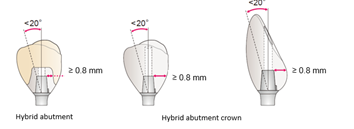
The angle of the axial surface should be within the range of 0 to 20 degrees.
When milling the block, keep the minimum wall thickness and necessary angle of the axial surface, referring to the illustration below.
What’s the maximum crown height that can be fabricated?
With KATANA™ Zirconia For IMPLANT, restorations up to 16.7 mm can be fabricated.
After sintering, the actual size of the restoration will be changed to roughly 80% of the original size.
How long does it take for each process?
It takes approximately 5 minutes for taking a digital impression, 10 minutes for designing, 10 minutes* for milling, 33 minutes for sintering, and 10 minutes for polishing or 20 minutes for glazing.
*In cases when using with the CEREC Primemill
Which milling method, wet or dry, is used to mill this product?
We recommend dry milling. It is possible to mill this product using wet milling, but wet milling might achieve a lower level of translucency than expected if cooling water is contaminated with silica-based glass ceramics (lithium disilicate glass, etc). When you use wet milling, it takes approx. additional 10 minutes to complete the sintering process, as drying step is added into the process.
What points should be kept in mind when using wet milling?
If milling KATANA™ Zirconia ONE series with a machine that is also used to mill a glass block or a resin block, it is necessary to wash the milling chamber and filter, and replace the cooling liquid before using. Insufficient cleaning of the chamber or filter will result in restorations with lower translucency.
Is it possible to mill with Dentsply Sirona’s CEREC inLab?
Yes, it can be used with the CEREC Software 5.2.12 / CEREC Software 5.3.3 / inLab CAM Software 22.7 / inLab CAM Software 24.1 / inLab CAD Software 22.4.1 or later is required.
Is it possible to use a furnace except for SpeedFire?
Yes, it is possible to use other furnaces. If a sintering furnace other than the CEREC SpeedFire is used, review the sintering schedules on Instructions for Use provided with the product. If you use wet milling, a drying process for 10 minutes at 200 ℃ (392°F) is necessary, prior to the sintering.
How to use the barcode and 7-digit number on the block?
The barcode is called “data matrix code” which is especially compatible for the CEREC Primemill barcode scan camera. The 7-digit number can be used with CEREC MC X/XL for material identification.
How many prosthetic made of KATANA™ Zirconia ONE For IMPLANT can be sintered at a time in CEREC SpeedFire?
Up to 3 prosthetics.
What is the finishing step after sintering?
After occlusal adjustment, finish the restoration by glazing or polishing.
Hand polishing is recommended for posterior cases, and glazing and staining is recommeded for anterior restorations, for the optimal results.
How should the anterior restorations be stained?
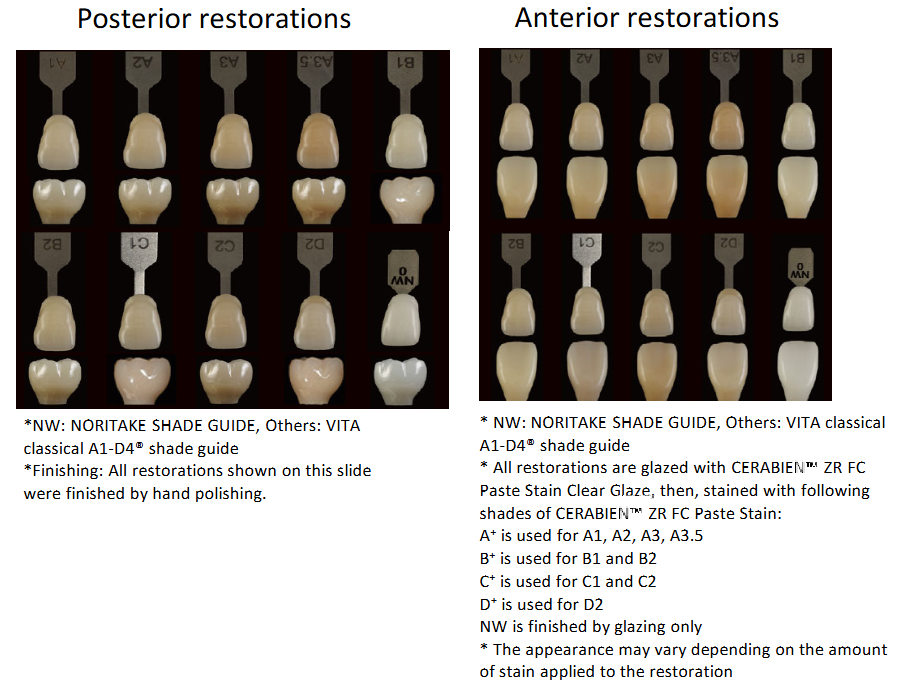
Firstly, apply CERABIEN™ ZR FC Paste Stain Glaze or Clear Glaze and bake. Then, apply either A+, B+, C+ or D+ of CERABIEN™ ZR FC Paste Stain over the whole restoration, and bake.
A+ is recommended for staining blocks such as A1, A2, A3, A3.5.
B+ is recommended for staining blocks such as B1 and B2.
C+ is recommended for staining blocks such as C1 and C2.
D+ is recommended for staining blocks such as D2.
Can veneered porcelain such as CERABIEN™ ZR or CZR PRESS LF be layered on the restoration?
No, it is not recommended to layer porcelain on the hybrid abutment or hybrid abutment crown made with KATANA™ Zirconia ONE For IMPLANT. In cases where porcelain layering is needed to achieve a higher level of aesthetics, select hybrid abutment and layer the porcelain on the separately created crown.
CERABIEN™ ZR FC Paste Stain (including Glaze, or Clear Glaze), on the other hand, can be applied on the restorations made with KATANA™ Zirconia ONE For IMPLANT.
What points should I keep in mind when adjusting restorations after sintering?
Adjust the restoration under running water or wet condition.
What glaze product do you recommend?
We recommend CERABIEN™ ZR FC Paste Stain or Dentsply Sirona's CEREC SpeedGlaze.
What is the glazing process?
After occlusal adjustment, polish the opposing areas using a silicon point containing diamond or a paste containing the same, followed by glazing.
Is it possible to use this product with spray glaze from other manufacturers?
Yes, it is possible to use Dentsply Sirona's CEREC SpeedGlaze. We do not have any data about Ivoclar Vivadent's glaze material. Please follow the Instructions for Use of the glaze material.
What is the polishing process?
After occlusal adjustment, polish the restoration using silicone points containing diamond particles. It is good practice to use three types of silicone points (coarse, regular and fine, respectively) to achieve good luster. Finish by polishing, using polishing paste containing diamond particles, such as PEARL SURFACE™ Z.
Which polishing tool or material do you recommend when finishing the restoration?
We recommend to use a silicon point containing diamond or a polishing paste containing diamond particles, such as PEARL SURFACE™ Z.
Can other manufacturers' stains be used?
Yes. You can use stains from other manufacturers, as long as the product is indicated for zirconia.
Does this product have fluorescence?
The product itself doesn’t have fluorescence, but it is possible to add fluorescence into the restoration with CERABIEN™ ZR FC Paste Stain.
What cement do you recommend for use with this product?
If you want better adhesion, please use cements that contain MDP, such as PANAVIA™ SA Cement Universal.
In addition, it is also possible to use various cements recommended for bonding with zirconia.
What is the preparation of the internal surfaces of the restoration before cementing?
Sandblast the internal surfaces of the restoration with 50 μm aluminium oxide and up to 2.0 bar (29 psi). Then, clean the adhesive surfaces in an ultrasonic bath or with alcohol or steam followed by drying it with an air stream.
For details, please refer to the Instructions for Use supplied with the product.
Which versions of CEREC Milling machines can be used for this product?
This product can be milled using any milling machine with the CEREC Software 5.2.12 / CEREC Software 5.3.3 / inLab CAM Software 22.7 / inLab CAM Software 24.1 / inLab CAD Software 22.4.1 or later is required.
Which software is needed to make a prosthetic?
CEREC Software 5.2.12 / CEREC Software 5.3.3 / inLab CAM Software 22.7 / inLab CAM Software 24.1 / inLab CAD Software 22.4.1 or later is required to design, mill, and sinter the prosthetic.
When should the milling bar be replaced with a new one?
It depends on clinical cases, however we suggest it should be done after approximately 50 blocks have been milled.
What is the difference from the KATANA™ Zirconia ONE (CROWN, BRIDGE)?
KATANA™ Zirconia ONE For IMPLANT is designed to be used as a mesostructure of an implant system, and has an access hole for connecting to a TiBase.
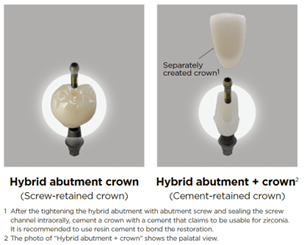
It can be used as a hybrid abutment crown (screw-retained crown) or a hybrid abument (cement-retained crown).
What is the difference between a hybrid abutment crown and a hybrid abutment?
A hybrid abutment crown (screw-retained crown) is a crown-shaped mesostructure of an implant system. A hybrid abutment (cement-retained crown), on the other hand, is an abutment-shaped mesostructure of an implant system, which needs a separately created crown.
When do you use each type of the restoration, a hybrid abutment and a hybrid abutment crown?
For general cases, a hybrid abutment crown can be used.
A hybrid abutment, which needs a crown separately, is used when an implant is placed in an orientation that is not parallel to that of the adjacent teeth, etc.
What points should I keep in mind when selecting shades of the block?
Please select a shade referring to the picture below.
KATANA™ Zirconia ONE For IMPLANT is designed to match the shade guide, when used as a posterior restoration finished by hand polishing. Hand polishing is recommended for posterior cases, and for anterior cases, glazing and staining is recommended for the optimal results.
What is the amount of Yttria?
It is the same as KATANA™ Zirconia STML disc, 7 to 10 wt%.
What is the crystal structure?
Approximately 60% is cubic structure and 40% is tetragonal.
What products do you recommend for sealing the screw channel?
To seal the screw channel, use a filling composite and a dental adhesive compatible with zirconium oxide, as used to produce a standard occlusal dental filling.
What kind of equipment do you need to introduce a complete system for using this product?
KATANA™ Zirconia ONE For IMPLANT is validated for use with the Dentsply Sirona's CEREC System, including AC Omnicam/Primescan, CEREC Milling units : MC XL, Primemill, or CEREC SpeedFire. Please ask Dentsply Sirona for detailed information.
What is the difference between this product and IPS e.max CAD? What are the advantages of this product over IPS e.max CAD?
KATANA™ Zirconia ONE For IMPLANT has a higher flexural strength (932 MPa) than IPS e.max CAD (565 MPa), which is a lithium disilicate glass*. KATANA™ Zirconia ONE series have a multi-layered structure, so it is easier to fabricate a natural tooth-colored restorations.
*Data source: Kuraray Noritake Dental Inc. According to ISO 6872: 2015.
Is it possible to perform color adjustment or staining of the restoration after sintering?
Yes, it is possible to do this with CERABIEN™ ZR FC Paste Stain.
What bur combination do you use?
Please use the combination of Bur 2.5 CS, Bur 1.0 CS and Bur 0.5 CS for CEREC Primemill. For CEREC MC XL, use a combination of Shaper 25 and Finisher 10. When you use wet milling with CEREC MC XL, select Shaper 25 RZ.
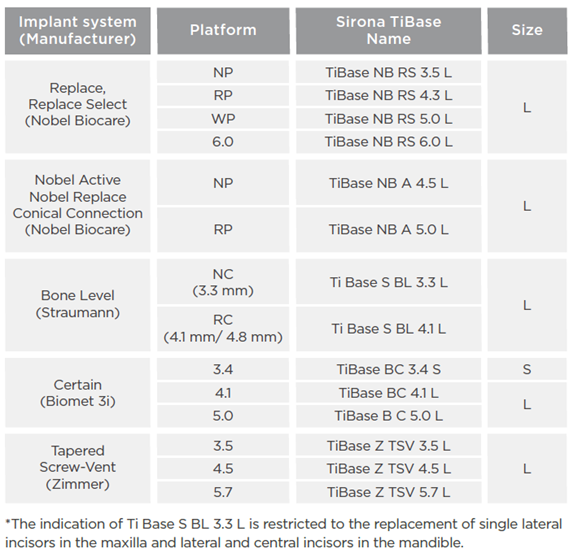
How should I select block S or L?
Please refer to the table below.
What mode can I mill KATANA™ Zirconia ONE For IMPLANT?
For both CEREC Primemill and CEREC MC XL, use the Fine mode.
How long does it take for sintering?
It takes 33 minutes.